Blockchain explained beyond the coins — how it is quietly rebuilding trust, ownership, and the internet itself.
Remember the last time you sent money overseas, only to be hit with a massive fee, a three-day wait, and the anxiety of wondering if it actually arrived? For decades, we have handed that power to middlemen. Blockchain is the technology quietly taking it back.
Whether it is a bank verifying your transfer, a tech giant storing your photos, or a lawyer confirming a contract — our entire digital life has been built on trusting centralized authorities to keep the record straight. We do not think about it. We just hand over our data, pay the fees, and hope for the best. But in 2026, a quiet revolution is underway, and it is challenging every assumption we have ever had about trust, ownership, and the internet.
Most people hear the word blockchain and immediately picture volatile digital coins and headlines about overnight millionaires. But the truth is far bigger and far more interesting than that. Blockchain is not just about money — it is fundamentally changing how global supply chains operate, how healthcare records are stored, how artists get paid, and how digital ownership actually works. The coin was just the beginning.
If you have always wanted blockchain explained in a way that actually makes sense — without the jargon, without the hype — you are in exactly the right place. This guide is going to walk you through how it works, why it matters, and what it means for the world you live in every single day.
So what exactly is a blockchain?
At its simplest, a blockchain is a distributed ledger — a massive digital spreadsheet shared across thousands of computers worldwide. Every time a new transaction happens, it gets recorded on this spreadsheet. And here is the part that changes everything: once something is written onto it, it can never be erased, altered, or hacked. Instead of one company holding the master copy of the records, thousands of independent computers hold identical copies. If a single computer tries to cheat and change a record, all the others instantly reject it. No boss. No bank. Just math.
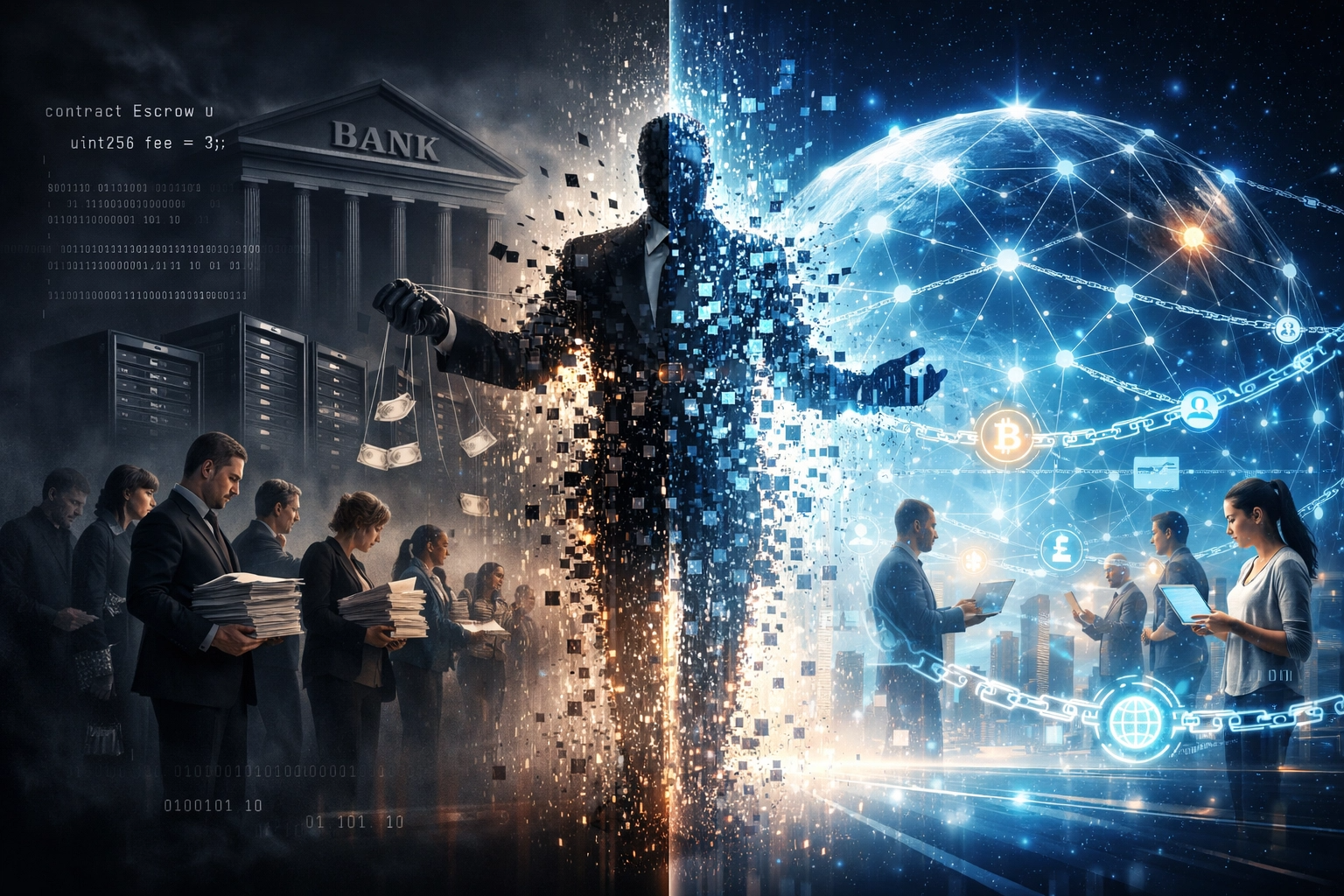
The old way vs. the blockchain way
The old way
A bank holds your money and keeps a private record of your balance. One company. One copy. One point of failure.
The blockchain way
Thousands of computers publicly agree on your balance. No single entity controls it. No single entity can corrupt it.
No middleman needed
A middleman used to charge fees to verify a deal. Now math and code do it automatically — instantly, and for almost nothing.
How does the network actually agree on what is true?
Because there is no boss in charge, blockchains use a consensus algorithm — a set of mathematical rules every computer must follow before a new block of data is added. The two most famous methods are Proof of Work and Proof of Stake. In Proof of Work, computers race to solve complex math puzzles. The winner adds the next block and earns a reward — this is what people mean by “mining.” It is ultra-secure but uses enormous amounts of electricity, which is how Bitcoin operates. Proof of Stake takes a different approach: instead of solving puzzles, users lock up their own digital assets as collateral to validate transactions. It is dramatically faster and uses 99% less energy — and it is the method Ethereum switched to in order to become more sustainable.
Beyond the coin — where blockchain gets truly exciting
Bitcoin proved that blockchain could move money without banks. But modern networks took things much further with something called smart contracts — self-executing agreements where the rules are written directly into code. Imagine booking a flight and a smart contract is set to say: if the flight is delayed by two hours, refund the customer automatically. No phone calls. No customer service queues. No waiting. Just instant, guaranteed execution. This programmability gave birth to Web3 — a new version of the internet where users actually own their data instead of renting it from tech giants. It also powers NFTs, which allow artists, musicians, and game developers to prove verifiable digital ownership of their work. Over 40% of major consumer brands now use blockchain-based loyalty and ownership systems. The coin was just the door — this is what is behind it.
Why is blockchain security such a big deal?
To tamper with a blockchain record, a hacker would need to simultaneously overpower more than 51% of thousands of computers spread across the entire globe — all at once. In a world where centralized databases at major corporations get breached and leak millions of passwords every year, blockchain offers something we rarely get in the digital world: a cryptographic vault that has never been broken at the base-layer level. The enterprise blockchain market is on track to exceed $250 billion by 2027. That kind of investment does not happen without a very real reason.
Conclusion
Think of a blockchain as a digital group chat where everyone has a notebook. When someone wants to send money or make a deal, they announce it to the group. Everyone checks their notebooks to confirm the person has the funds. If everyone agrees, they all write it down at the exact same time — in pen, permanently, with no way to erase it. You do not need a bank manager watching the group because the group watches itself using math. What started as a way to move digital money is now being used to pay artists automatically, track food from farm to shelf, and build a version of the internet where you do not have to blindly trust corporations — because you can trust the code instead. The middleman had a good run. Its time is up.
Leave a Reply