Category: Uncategorized

  • The Middleman Is Gone — And This Technology Is the Reason Why

    The Middleman Is Gone — And This Technology Is the Reason Why

    Blockchain explained beyond the coins — how it is quietly rebuilding trust, ownership, and the internet itself.

    Remember the last time you sent money overseas, only to be hit with a massive fee, a three-day wait, and the anxiety of wondering if it actually arrived? For decades, we have handed that power to middlemen. Blockchain is the technology quietly taking it back.

    Whether it is a bank verifying your transfer, a tech giant storing your photos, or a lawyer confirming a contract — our entire digital life has been built on trusting centralized authorities to keep the record straight. We do not think about it. We just hand over our data, pay the fees, and hope for the best. But in 2026, a quiet revolution is underway, and it is challenging every assumption we have ever had about trust, ownership, and the internet.

    Most people hear the word blockchain and immediately picture volatile digital coins and headlines about overnight millionaires. But the truth is far bigger and far more interesting than that. Blockchain is not just about money — it is fundamentally changing how global supply chains operate, how healthcare records are stored, how artists get paid, and how digital ownership actually works. The coin was just the beginning.

    If you have always wanted blockchain explained in a way that actually makes sense — without the jargon, without the hype — you are in exactly the right place. This guide is going to walk you through how it works, why it matters, and what it means for the world you live in every single day.

    So what exactly is a blockchain?

    At its simplest, a blockchain is a distributed ledger — a massive digital spreadsheet shared across thousands of computers worldwide. Every time a new transaction happens, it gets recorded on this spreadsheet. And here is the part that changes everything: once something is written onto it, it can never be erased, altered, or hacked. Instead of one company holding the master copy of the records, thousands of independent computers hold identical copies. If a single computer tries to cheat and change a record, all the others instantly reject it. No boss. No bank. Just math.

    The old way vs. the blockchain way

    The old way

    A bank holds your money and keeps a private record of your balance. One company. One copy. One point of failure.

    The blockchain way

    Thousands of computers publicly agree on your balance. No single entity controls it. No single entity can corrupt it.

    No middleman needed

    A middleman used to charge fees to verify a deal. Now math and code do it automatically — instantly, and for almost nothing.

    How does the network actually agree on what is true?

    Because there is no boss in charge, blockchains use a consensus algorithm — a set of mathematical rules every computer must follow before a new block of data is added. The two most famous methods are Proof of Work and Proof of Stake. In Proof of Work, computers race to solve complex math puzzles. The winner adds the next block and earns a reward — this is what people mean by “mining.” It is ultra-secure but uses enormous amounts of electricity, which is how Bitcoin operates. Proof of Stake takes a different approach: instead of solving puzzles, users lock up their own digital assets as collateral to validate transactions. It is dramatically faster and uses 99% less energy — and it is the method Ethereum switched to in order to become more sustainable.

    Beyond the coin — where blockchain gets truly exciting

    Bitcoin proved that blockchain could move money without banks. But modern networks took things much further with something called smart contracts — self-executing agreements where the rules are written directly into code. Imagine booking a flight and a smart contract is set to say: if the flight is delayed by two hours, refund the customer automatically. No phone calls. No customer service queues. No waiting. Just instant, guaranteed execution. This programmability gave birth to Web3 — a new version of the internet where users actually own their data instead of renting it from tech giants. It also powers NFTs, which allow artists, musicians, and game developers to prove verifiable digital ownership of their work. Over 40% of major consumer brands now use blockchain-based loyalty and ownership systems. The coin was just the door — this is what is behind it.

    Why is blockchain security such a big deal?

    To tamper with a blockchain record, a hacker would need to simultaneously overpower more than 51% of thousands of computers spread across the entire globe — all at once. In a world where centralized databases at major corporations get breached and leak millions of passwords every year, blockchain offers something we rarely get in the digital world: a cryptographic vault that has never been broken at the base-layer level. The enterprise blockchain market is on track to exceed $250 billion by 2027. That kind of investment does not happen without a very real reason.

    Conclusion

    Think of a blockchain as a digital group chat where everyone has a notebook. When someone wants to send money or make a deal, they announce it to the group. Everyone checks their notebooks to confirm the person has the funds. If everyone agrees, they all write it down at the exact same time — in pen, permanently, with no way to erase it. You do not need a bank manager watching the group because the group watches itself using math. What started as a way to move digital money is now being used to pay artists automatically, track food from farm to shelf, and build a version of the internet where you do not have to blindly trust corporations — because you can trust the code instead. The middleman had a good run. Its time is up.


  • We Lock Our Cars to Run Into a Shop — But We Leave Our Entire Digital Life Wide Open

    We Lock Our Cars to Run Into a Shop — But We Leave Our Entire Digital Life Wide Open

    10 simple, powerful habits that will lock down your digital life in 2026 — no tech degree required.

    Millions of people still use “Password123” to protect their bank accounts in 2026. We lock our cars for a two-minute store run, but we leave our entire digital identity — our money, our conversations, our personal records — completely unguarded. It sounds crazy. And it is.

    In 2026, the digital world is not separate from your physical life anymore — it is woven directly into it. Your phone holds your banking apps. Your email holds your most private conversations. Your laptop holds your identity, your work, and years of personal history. And as hackers grow smarter with AI-powered tools, the gap between a secure person and a vulnerable one is getting wider every single month.

    Here is the thing most people do not realise: staying safe online is not about being a technology expert. It is about building a handful of smart, simple habits — the kind that take minutes to set up but protect you for years. The vast majority of hacks in the world do not happen because a genius cracked a complex code. They happen because someone used a weak password, clicked the wrong link, or left a door open that could have been locked with one tap.

    You do not need to do everything at once. You just need to start. Here are the 10 most powerful, most practical steps you can take right now to lock down your digital life — explained in plain, human language, with zero jargon and zero overwhelm.

    Phase 1 — Locking the front door: passwords and logins

    The overwhelming majority of hacks happen because someone simply guessed or stole a password. Stop making it easy for them.

    1. Use a password manager

    If you reuse the same password across sites, you are one breach away from losing everything. A password manager creates and remembers impossibly complex passwords for every site — you only remember one master password.

    2. Turn on two-factor authentication

    Even if a hacker steals your password, 2FA stops them cold by requiring a second code to log in. Skip SMS codes — use an authenticator app like Google Authenticator instead, as texts can be intercepted.

    3. Enable biometric security

    Passwords can be stolen. Your face cannot. Turn on Face ID or fingerprint scanning on your phone and laptop — it is faster, easier, and mathematically far harder for thieves to bypass.

    Phase 2 — Building your defensive walls: networks and devices

    Locking your accounts is only half the battle. You also need to protect the devices themselves and the internet connections they travel through.

    4. Use a VPN on public Wi-Fi

    Free airport or coffee shop Wi-Fi is a hacker’s playground. A VPN scrambles your internet traffic with military-grade encryption, making your data completely invisible to anyone else on the same network.

    5. Keep your firewall turned on

    Your operating system has a built-in firewall — a digital bouncer that blocks unauthorised connections from reaching your computer. Check your settings right now and make sure it is switched on. It takes five seconds.

    6. Install real antivirus software

    Built-in protections are a good start, but modern threats need dedicated antivirus software. A premium option actively scans downloads, blocks malicious scripts, and catches advanced malware before it roots into your system.

    Phase 3 — Outsmarting the enemy: the human habits that matter most

    The strongest software in the world cannot save you if you voluntarily hand over your own keys. These final four habits are all about changing your behaviour — and they are the ones most people overlook entirely.

    7. Spot phishing like a pro

    Never click links in unexpected emails. If “Amazon” says your account is locked, open a new tab and type amazon.com yourself. That one habit alone blocks the most common attack on the planet.

    8. Practise secure browsing

    Install an ad-blocker, clear your cookies regularly, and always check for the padlock icon (HTTPS) next to the URL before entering any payment details on a website.

    9. Review your app permissions

    Stop blindly clicking “I Agree.” Does a flashlight app really need access to your microphone and contacts? Go through your phone’s permissions right now and revoke anything that does not make sense.

    10. Set up dark web monitoring

    If your data has already been leaked in a corporate breach, you need to know immediately. Dark web monitoring services scan the hidden internet for your email, passwords, and identity — before criminals can use them.

    Conclusion

    Securing your digital life is just like securing your home. You need strong locks on the doors — that is your password manager and two-factor authentication. You need to make sure nobody is peeking through your windows — that is your VPN on public Wi-Fi. And you need to be smart enough not to open the door for a stranger in a fake delivery uniform — that is every phishing email you have ever received. You do not need to do all ten of these things today. Start with one. Download a password manager tonight. Turn on 2FA for your email tomorrow. Build the habit slowly, and before long you will be a hard target — the kind of person hackers look at and simply move on from. Your data is worth protecting. The tools to do it are free. The only thing left is the decision to start.

  • Your Digital Front Door Is Wide Open — And Someone Is Already Walking In

    Your Digital Front Door Is Wide Open — And Someone Is Already Walking In

    The real cyber threats of 2026, explained in plain language — and exactly how to lock your digital life down for good.

    You would never leave your front door wide open, your wallet on the porch, and your filing cabinet on the lawn before going to sleep. And yet, millions of people — and massive corporations — leave their digital doors completely unlocked every single day.

    In 2026, the digital world is more connected than it has ever been. From the smart thermostat in your home to the global banking systems that hold your life savings, everything is online. Everything is accessible. And that convenience — that beautiful, effortless convenience we have all grown addicted to — comes with a very dark side: a shadow industry of hackers working around the clock, every single day, looking for a way in.

    The average cost of a single data breach has now skyrocketed past $5 million for businesses. Cybercrime is projected to cost the world over $10.5 trillion annually in 2026 — more profitable than the global trade of all major illegal drugs combined. This is not a niche IT problem anymore. It is a survival skill. And whether you are a student, a small business owner, or someone who simply has a phone in their pocket, it affects you directly.

    The good news is that protecting yourself does not require a computer science degree. It requires understanding what you are up against — and then taking a few smart, simple steps. This guide is going to give you both, in the most straightforward way possible. No jargon. No fear-mongering. Just the truth about what is out there and how to stay ahead of it.

    So what exactly is cybersecurity?

    At its core, cybersecurity is the practice of defending computers, networks, devices, and data from malicious attacks. Think of it as a digital bodyguard — one that sets up layers of defence to prevent unauthorised access. It covers everything from network security, which guards the pathways between computers, to encryption, which scrambles your data so thoroughly that even if a hacker steals it, they cannot read a single word of it. But to build a good defence, you first need to understand how the enemy attacks.

    The four biggest threats out there right now

    Phishing

    A fake email pretending to be your bank tricks you into clicking a bad link. It is the number one cause of stolen passwords in the world.

    Social Engineering

    Hackers manipulate you psychologically — calling as fake IT support — until you voluntarily hand over your own login details.

    Malware

    Malicious software that secretly installs itself, tracks your keystrokes, steals your files, and runs silently in the background.

    Ransomware

    Locks you out of your own files and demands a crypto ransom to return them. A business falls victim every 11 seconds worldwide.

    Your protection toolkit — what actually works

    Here is the truth most people do not realise: implementing just a few basic security tools makes you a hard target, and most hackers will give up and move on to easier victims. Antivirus software acts like your immune system, catching known threats before they can execute. A firewall works like a bouncer at the door — monitoring everything coming in and going out, and blocking anything suspicious. A VPN creates an encrypted tunnel between you and the internet, hiding your data and location entirely — it is non-negotiable if you ever use public Wi-Fi at a café or airport. And for businesses, Zero Trust is the new gold standard: a security model that operates on one simple rule — never trust, always verify. By 2026, over 70% of enterprise companies have already made the switch. None of these tools are complicated. They just need to be turned on.

    The good guys fighting back — ethical hacking

    If hackers are so clever, how do we ever stay ahead? The answer is that companies hire their own hackers first. Ethical hacking — also called white hat hacking — is a booming industry where brilliant security experts are paid to legally break into a company’s systems and find the weak spots before the bad guys do. They think exactly like an attacker, because they were trained like one. It is one of the most important and fastest-growing careers in technology, and it is a big reason why the best-secured systems in the world stay one step ahead.

    Conclusion

    Cybersecurity is just digital common sense. Just like you would never hand your house keys to a stranger on the street, you should never hand your password to an unverified email. The internet in 2026 is full of traps — some try to trick you into clicking bad links, some try to lock your files and demand money, and others try to sneak in so quietly you never notice them at all. But protecting yourself does not have to be complicated. Use a good antivirus. Turn on your firewall. Use a VPN on public Wi-Fi. Never reuse the same password twice. Build these simple walls around your digital life, and the bad guys will almost always move on to an easier target. Stay smart, stay suspicious, and keep your digital doors locked. The lock is free — the breach is not.

  • You Are Already Living in the Cloud — You Just Don’t Know It Yet

    You Are Already Living in the Cloud — You Just Don’t Know It Yet

    A beginner’s guide to the invisible technology running your world — in plain, human language.

    Think about the last time you watched a Netflix show, sent a WhatsApp message, or saved a photo on your phone. None of that lived on your device. It lived somewhere else — somewhere massive, somewhere powerful, somewhere most people never think about. That somewhere is the cloud.

    Not too long ago, every business had to buy giant, expensive computer servers, lock them in a room, and hire teams just to keep them running. One crash, one power cut, and everything went down. It was stressful, costly, and honestly — a bit ridiculous. Then cloud computing arrived and flipped the whole model upside down. Instead of owning the machine, you just rent the power. Instead of building the well, you turn on the tap.

    In 2026, cloud computing is not a trend anymore — it is the backbone of the entire internet. The global market has crossed $905 billion, and by 2034 it is expected to hit nearly $3 trillion. From the app on your phone to the website of your favourite store, almost everything runs on the cloud. And yet, most people have never stopped to ask: what actually is this thing? How does it work? And should I care?

    The answer to that last question is a loud yes. Because understanding the cloud means understanding the world you already live in — and this guide is going to break it all down in the simplest, most human way possible. No jargon. No confusion. Just clarity.

    So what exactly is cloud computing?

    At its simplest, cloud computing means using someone else’s computers — over the internet — to store your data, run your software, or power your applications. Those “someone else’s computers” are actually massive warehouses called data centers, filled with thousands of servers, located all around the world. When you upload a photo, stream a song, or open a Google Doc, a request zips across the internet to one of these centers and comes back to you in milliseconds. The magic is real — it is just happening very, very far away.

    Who runs the cloud? Meet the Big Three.

    • Amazon Web Services
    • The oldest and largest. Powers a huge chunk of the internet you use every day.
    • Microsoft Azure
    • The corporate favourite. Plugs perfectly into Windows and business tools companies already use.
    • Google Cloud
    • The smart one. Built for AI, data analytics, and machine learning at massive scale.

    The pizza theory of cloud services

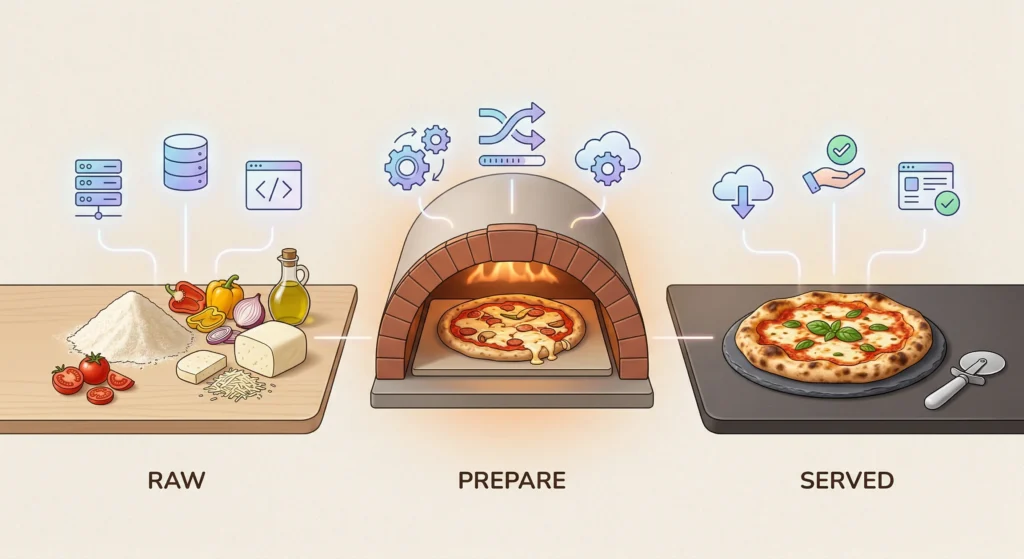
    Cloud services come in three flavours, and the easiest way to understand them is to think about ordering a pizza. With IaaS (Infrastructure as a Service), you buy the raw ingredients and cook it yourself — you rent the servers and handle everything else. With PaaS (Platform as a Service), the kitchen is ready, the oven is hot, you just bring your recipe — developers write code without worrying about the hardware underneath. And with SaaS (Software as a Service), you walk into a restaurant and the pizza is already on the table — apps like Gmail, Slack, and Dropbox are fully built and ready to use. You do not touch anything under the hood.

    Is my data safe up there?

    This is the question everyone whispers. The answer is yes — and often, your data is safer in the cloud than on your own laptop. The Big Three invest billions into security every year. They encrypt your data so thoroughly that even if someone stole it, they would see nothing but gibberish. That said, 54% of cloud data in 2026 is classified as highly sensitive, which is exactly why providers are now using AI-driven security systems that detect threats faster than any human team could.

    What is coming next — Edge Computing

    The cloud is already fast. But the next evolution — Edge Computing — makes it even faster by processing data closer to where you are, instead of bouncing it to a data center halfway across the world. Think of a self-driving car that cannot afford even a split-second delay. Edge computing handles that decision right inside the car or at the nearest cell tower. It is the cloud, but smarter and closer.

    Conclusion

    Cloud computing is simply renting computer power, storage, and software over the internet — instead of buying it all yourself. It is why you can stream, collaborate, and work from anywhere. It is why startups can launch overnight without buying a single server. It is why your photos survive even when your phone breaks. The cloud is not some distant tech concept — it is already woven into your daily life, quietly doing the heavy lifting so you don't have to. And as AI and smart devices keep growing, it will only become more essential. You were already using it. Now you know exactly what it is.