Category: General Knowledge

  • How to Check If a Website Is Safe Before You Click

    How to Check If a Website Is Safe Before You Click

    Picture this: you’re scrolling through social media when an ad for those expensive sneakers you’ve been eyeing pops up, priced at an unbelievable 80% off. Your heart races as you click the link, but a nagging thought suddenly hits you—how to check if a website is safe before handing over your credit card details? It’s a scenario almost everyone has faced, hovering your mouse over a link and wondering if it’s going to lead to a sweet deal or a complete disaster.

    The truth is, cybercriminals are getting smarter every single day, creating duplicate storefronts and malicious links that look virtually identical to the real thing. This growing threat of online fraud means that relying purely on your gut feeling is no longer enough to protect your hard-earned money and personal data. Every internet user, regardless of their technical skills, needs to understand how to navigate around these digital traps.

    In this guide, you will learn exactly what to look for before you ever hit that checkout button or type in your password. We’ll break down the warning signs of fraudulent pages and give you simple, actionable tools you can use immediately. By the time you finish reading, you’ll have the confidence to browse, shop, and click without fear.

    Look Beyond the Padlock: The Basics of HTTPS

    For years, we were taught that a simple visual check was enough to guarantee our security. While looking at your browser’s address bar is a great first step, it is only part of the puzzle.

    What HTTPS Actually Means

    When you look at a web address, you should see HTTPS rather than just HTTP. That extra “S” stands for “Secure.” It indicates that the site has an active SSL Certificate, which encrypts the data passing between your computer and the website’s server. When this encryption is active, you will typically see a little Padlock Icon next to the URL.

    However, you need to know a very important caveat:

    “A secure padlock doesn’t guarantee a safe site; it just guarantees your connection to that site is encrypted. Cybercriminals use encryption too, which is why verifying the actual domain is critical to your online safety.” — National Cybersecurity Alliance

    Because scammers can easily obtain an SSL Certificate for a fake site, seeing the Padlock Icon doesn’t mean the people running the site are honest. It just means the data you send them—like your credit card numbers—is securely transmitted to the scammers.

    How to Check If a Website Is Safe Using Dedicated Tools

    When your eyes deceive you, let technology do the heavy lifting. If you are wondering how to tell if a website is legit, your best bet is to use an automated website safety checker. These tools scan URLs against massive databases of known threats.

    Top Safety Checkers You Can Use Right Now

    • Google Safe Browsing: This is a fantastic, free tool provided by Google. You simply paste the URL into their transparency report page, and it will instantly tell you if the site is currently hosting anything dangerous.
    • VirusTotal: If you want a deep dive, this is your go-to platform. VirusTotal analyzes suspicious files and URLs to detect types of Malware and malicious breaches. It aggregates data from dozens of antivirus scanners into one easy-to-read report.
    • URLVoid: This service cross-references a website against multiple blacklist engines. It gives you a detailed safety report and helps you quickly spot malicious behavior.
    • Norton Safe Web: Powered by a trusted name in cybersecurity, this tool analyzes sites to see how they will affect your computer. It checks for computer threats, identity threats, and annoyance factors.

    Whenever you feel a spike of doubt, pause and run the link through a website safety checker. It takes five seconds and could save you hours of headaches.

    Investigate the Domain Age and Registration

    Scam websites usually don’t last very long. Cybercriminals set them up, rip people off, and abandon them as soon as they get caught or blocked by internet service providers. Because of this “burn and churn” tactic, checking a site’s history is incredibly revealing.

    Why Domain Age Matters

    If you are looking at an online store claiming to have thousands of five-star reviews, but you find out the website was registered just three days ago, you have spotted a major red flag. Checking the Domain Age is a foolproof way to verify a company’s claims. You can use free “WHOIS” lookup tools online to see exactly when a domain was registered and who owns it. Legitimate businesses generally have older, established domain histories.

    Trust Your Eyes: How to Spot a Fake Website

    Sometimes, the best defense against digital threats is plain old common sense. Phishing attacks rely heavily on creating a sense of urgency and hoping you don’t look too closely at the details. If you slow down, the cracks in their facade become obvious.

    Red Flags to Watch For

    • Weird URLs: Scammers love to use typosquatting. You might think you are visiting “amazon.com,” but a closer look reveals you are actually on “arnazon.com” (using an ‘r’ and an ‘n’). Always double-check the spelling in the address bar.
    • Poor Grammar and Spelling: Legitimate companies have editors and marketing teams. If a homepage is riddled with awkward phrasing, weird formatting, and obvious spelling mistakes, close the tab immediately.
    • Unbelievable Deals: We all love a bargain, but if a brand new laptop is selling for $40, you aren’t getting a deal—you are getting robbed.
    • Strange Payment Methods: If an online retailer insists you pay via wire transfer, cryptocurrency, or gift cards, walk away. These methods are untraceable and non-refundable.

    If you are ever unsure about how to check if a website is safe, take a step back and evaluate the overall quality of the page. If it feels cheap, rushed, or overly aggressive in demanding your personal info, it is likely a scam.

    Protect Your Devices from Hidden Threats

    Sometimes you don’t even have to type in your password to become a victim. Merely visiting a compromised website can silently download Malware onto your device in the background. This is known as a “drive-by download.”

    To prevent this, you should always keep your web browser and operating system updated to the latest versions. Modern browsers have excellent built-in defenses that will physically block you from entering known malicious sites. Combine these automated defenses with your new knowledge of how to check if a website is safe, and you create an incredibly strong shield against online criminals.

    Take Control of Your Digital Safety

    You hold the keys to your digital security, and navigating the web doesn’t have to feel like walking through a minefield. By pausing for just a few seconds to run these visual checks and utilize safety tools, you lock the door on cybercriminals and protect your peace of mind. Stay vigilant, trust your instincts when a deal looks too good to be true, and never let scammers have the last laugh.


    Meta Description: Wondering how to check if a website is safe? Read our expert guide to spot fake links, avoid scams, use safety checkers, and browse the internet securely.


  • AI-Driven Cybersecurity: The Arms Race Has Gone Autonomous

    AI-Driven Cybersecurity: The Arms Race Has Gone Autonomous

    The Threat Landscape in 2026

    Cybersecurity in 2026 is not a cat-and-mouse game. It is a cat-and-cat game, where both sides have gone fully autonomous. Attackers now deploy AI-generated spear-phishing campaigns that produce personalized emails indistinguishable from those written by trusted colleagues. They use AI to scan for vulnerabilities at scale, test exploits automatically, and adapt tactics in real time based on what defenses they encounter.

    Against this backdrop, the traditional reactive security posture is structurally inadequate. A security operations team reviewing alerts generated by yesterday’s attack patterns will always be behind an adversary using today’s AI tools. Gartner’s response — and the direction the entire industry is moving — is what they call preemptive cybersecurity: shifting the defensive posture from detection and response to prediction and prevention.

    What Proactive AI Security Actually Looks Like

    The practical manifestation of this shift involves several converging capabilities. Behavioral AI models establish baselines of normal activity for every user, device, and application in an environment, then flag deviations with high precision before they escalate into incidents. Autonomous threat-hunting agents continuously scan the attack surface for vulnerabilities at a speed and breadth no human team can match.

    The concept of digital provenance — verifying the origin and integrity of software, data, and AI-generated content — is also gaining significant traction. In a world where AI can generate convincing code, documents, and communications at scale, the ability to cryptographically verify that a piece of software is what it claims to be becomes a foundational security requirement.

    The Human Factor Has Not Gone Away

    The most sophisticated AI security stack in the world does not protect an organization from an employee clicking a malicious link in a convincing AI-generated email. Social engineering remains the most reliable attack vector precisely because it exploits human psychology rather than technical vulnerabilities. The organizations with the strongest security postures combine AI-powered technical defenses with continuous, realistic security awareness programs — not the annual compliance checkbox training that most organizations still rely on.

    “We are no longer defending against hackers. We are defending against hacker-trained AI systems that never sleep, never take weekends off, and learn from every failed attempt.”

    Conclusion

    The robot revolution is not coming. It is already on the warehouse floor, in the surgical suite, and moving through the fields. The organizations that treat physical AI as a distant future technology will spend the next five years catching up to competitors who treated it as a present-day operational decision. The machines are ready. The real question is whether the humans leading these organizations are.

  • The Five Forces Rewiring the Tech World in 2026

    The Five Forces Rewiring the Tech World in 2026

    Agentic AI, autonomous coding, quantum breakthroughs, proactive cybersecurity, and physical robotics are no longer emerging — they are arriving. Here is what every business leader needs to understand right now.

    Imagine explaining the state of enterprise technology in 2026 to someone who fell asleep in 2022. You would need to tell them that AI agents now schedule meetings, write production code, and manage supply chains — often without a single human keystroke in the loop. That quantum computers have stopped being laboratory curiosities and begun solving problems classical machines cannot. That warehouses run on robots guided by neural networks, not conveyor belts and clipboards. And that hackers, too, have gone fully autonomous.

    The honest response from our 2022 sleeper would probably be: that sounds like science fiction.

    It is not. Every one of these developments is unfolding right now, accelerating at a pace that has left even seasoned CIOs scrambling to separate signal from noise. This report cuts through the hype to map the five technological forces that will define competitive advantage through the end of this decade — what they are, where they are creating real value today, what is genuinely hard about deploying them, and what comes next.

    “The real disruption is not AI replacing humans — it is humans who use AI replacing those who do not.”

    Agentic AI: The Pilot Phase Is Over — So Why Are Most Companies Still Stuck In It?

    Understanding the Shift

    • There is a meaningful distinction between AI that responds and AI that acts. For the first few years of the generative AI era, enterprises deployed the former: chat interfaces, summarization tools, Q&A bots. Useful, certainly. Transformative, not quite. Agentic AI represents a fundamentally different proposition. An AI agent does not wait to be asked — it perceives a goal, reasons through the steps required to achieve it, takes actions (browsing the web, querying databases, calling APIs, writing and running code), evaluates the results, and iterates.
    • Multi-agent systems extend this further. Rather than a single agent working alone, you get networks of specialized agents collaborating: one researching, one writing, one fact-checking, one formatting — coordinated by an orchestrating layer that routes tasks and arbitrates conflicts. Gartner describes this architecture as one of the top strategic technology trends for 2026, noting that modular agent collaboration dramatically expands what automation can achieve.

    The Gap Between Ambition and Reality

    Here is the uncomfortable truth buried in the data. Despite the volume of boardroom conversation about agentic AI, Deloitte’s 2025 Emerging Technology Survey found that only 11% of organizations have agents running in production, even though 38% are piloting them. That is a cavernous gap — one that tells a story not about disinterest, but about the genuine complexity of moving from a controlled demo to a live enterprise system where errors have consequences.

    ▸  11%  — of organizations have agentic AI in production (Deloitte, 2025)

    ▸  38%  — are actively piloting agentic systems

    ▸  ~73%  — of agentic AI projects may fail to reach full deployment by 2027, per Gartner estimates

    The reasons are predictable in retrospect. Enterprise data is messy. Governance frameworks are immature. Legal teams are nervous about autonomous decision-making. And the integration work required to connect agents to legacy systems is, frankly, brutal. As one Fortune 500 CTO observed recently: “We had a beautiful pilot. It fell apart the moment we connected it to our actual ERP.”

    Where It Is Working

    The sectors showing real production traction are those with structured, high-volume workflows: financial services (automated compliance monitoring, fraud detection chains), healthcare (patient record summarization and triage routing), and software engineering. In logistics, Amazon has deployed multi-agent AI coordination systems — its DeepFleet platform now orchestrates over one million warehouse robots, improving route efficiency by 10% across facilities.

    The lesson from early adopters is consistent: start with workflows that are high-frequency, well-documented, and have clear success criteria. Agentic AI thrives on clarity. It struggles with ambiguity, edge cases, and the informal institutional knowledge that lives in people’s heads.

    “Agentic AI does not fail in the demo. It fails in the integration. That is where the real work begins.”

    Conclusion

    The pilot phase was never really about technology. It was about organizational readiness. The companies that will lead this decade are not those with the most impressive demos — they are those that did the unglamorous work of cleaning their data, documenting their processes, and building governance frameworks that let agents operate with appropriate autonomy. The demo is easy. The integration is the real test. And the real winners are already in the middle of it.

  • The Internet Is No Longer Free — It’s Controlled by a Few Powerful Systems

    The Internet Is No Longer Free — It’s Controlled by a Few Powerful Systems

    You didn’t lose the open internet. It was bought, boxed up, and sold back to you as a convenience. Today, the digital frontier is dead—replaced by a heavily guarded corporate state.

    We still use antiquated words like “web” or “highway” as if we are freely surfing across decentralized, independent servers. The reality is far more clinical. We are navigating private walled gardens owned by a cartel of tech giants. This isn’t a fringe conspiracy theory; it’s a highly optimized business model.

    The data power of big tech has quietly swallowed the physical and psychological infrastructure of human connection. The shift didn’t happen overnight. It was a slow, deliberate consolidation, executed while we were distracted by the shiny allure of seamless connectivity.

    We traded the historic resilience of a decentralized network for the sleek, frictionless convenience of centralized corporate hubs. Now, the bill is coming due.

    This is no longer a technology problem — it is a power structure.

    The Invisible Plumbing of the Digital World

    To understand this takeover, you have to look past the screens and into the ground. When you type a URL, you assume you are directly connecting to a standalone website. But your digital request almost certainly runs through physical infrastructure owned by Amazon, Microsoft, or Google.

    Through Amazon Web Services (AWS) and Microsoft Azure, these corporate behemoths control roughly two-thirds of the global cloud computing market. AWS alone commands over 30% of the entire global cloud industry.

    They provide the invisible plumbing of the modern world. A single technical glitch at AWS doesn’t just take down a website; it paralyzes banks, grounds airlines, and silences international streaming platforms in seconds.

    They don’t just host the internet; they are the internet.

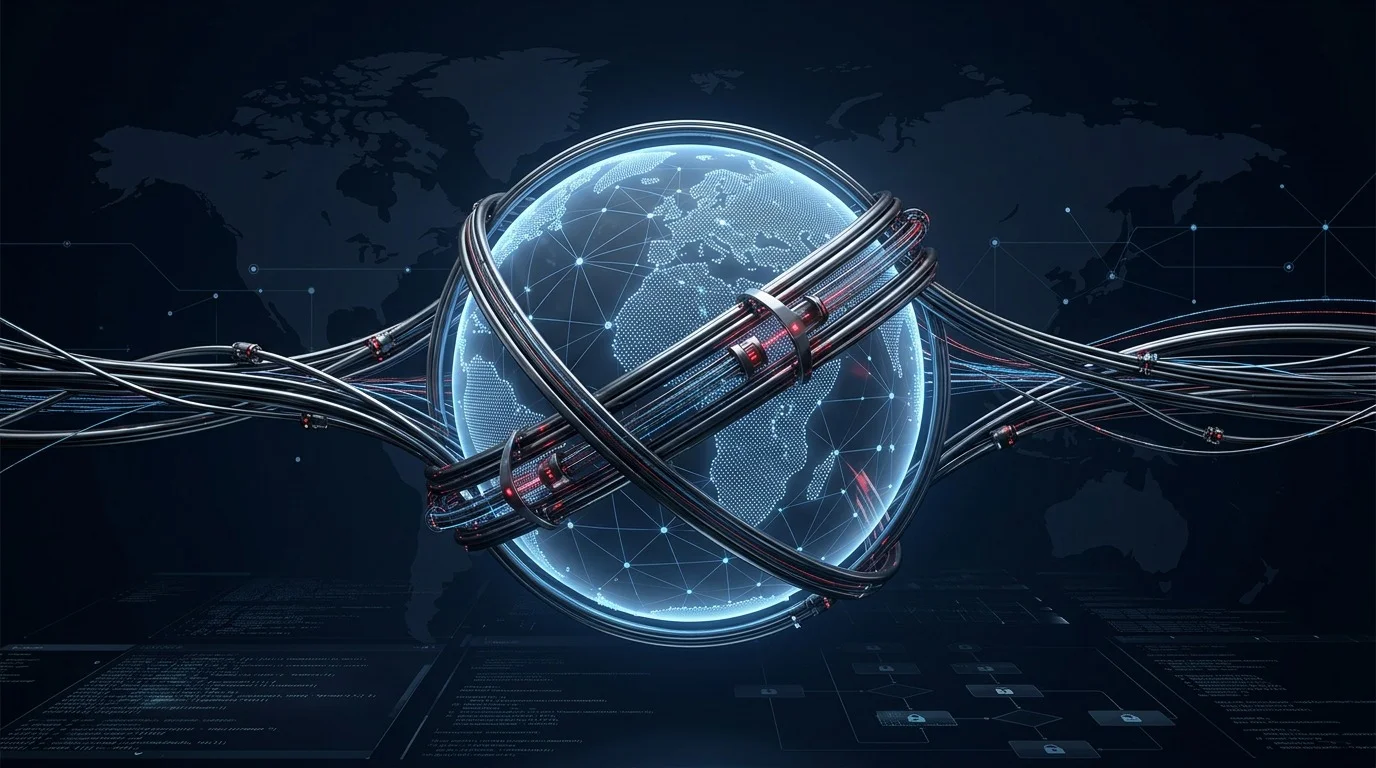
    Google compounds this monopoly by physically laying massive underwater fiber-optic cables that carry internet traffic across entire oceans. This level of internet control by big tech fundamentally reshapes who holds authority over global communications. While international organizations like ICANN attempt to handle the governance of domain names and ensure the internet’s address book functions properly, they operate firmly in the shadow of this physical monopoly. ICANN can manage the directory, but the pipes carrying the global pulse of information belong to private executives in Silicon Valley.

    You Are the Raw Material

    But owning the physical pipes is merely the foundational step. The real prize is the human behavior flowing through them. Welcome to the Data Economy, a hyper-efficient, invisible marketplace where your attention, your location, and your psychological vulnerabilities are the world’s most valuable commodities.

    Meta and Google did not become trillion-dollar empires simply by building better software. They achieved unprecedented wealth through total global data control. With Google handling over 8.5 billion searches daily and Meta platforms reaching over 3 billion users globally, the scale of their surveillance is unprecedented. Every click, every lingering pause on a video, and every late-night search is meticulously extracted, packaged, and sold to the highest bidder.

    Think about the last time you used a “free” service. When you download a navigation app, you are explicitly trading your real-time physical location for driving directions.

    When you utilize a free webmail platform, automated algorithms scan the text of your private correspondence to serve you eerily accurate, personalized advertisements. You aren’t the customer; you are the raw material.

    The data power of big tech isn’t just about targeting you with shoes you looked at yesterday. It is about behavioral prediction at scale. It is a system engineered to anticipate your needs, influence your political sentiments, and shape public discourse with terrifying, algorithmic accuracy.

    The Global Pushback

    This unprecedented level of big tech dominance has finally triggered a global alarm. We have reached a tipping point where a single technology CEO possesses more direct influence over global communication and information flow than elected heads of state.

    Global institutions are waking up to the threat. The United Nations has raised urgent red flags regarding how unchecked corporate surveillance threatens fundamental human rights and the stability of democratic elections worldwide.

    Simultaneously, high-level dialogues at the World Economic Forum have sharply pivoted. The tone has shifted from blindly celebrating “disruptive innovation” to desperately trying to mitigate the severe systemic risks posed by these digital monopolies.

    But regulating these giants feels like trying to catch smoke. They deploy massive, highly coordinated lobbying armies. They hide behind opaque, proprietary algorithms that government regulators simply do not possess the technical expertise to understand, let alone dismantle. Without drastic intervention, this internet control by big tech will only deepen.

    The Splintering of the Web

    Frustrated by the painstakingly slow pace of global consensus, the fight has evolved into a localized battle for Digital Sovereignty. Nations and political blocs are flatly refusing to let a handful of American corporations dictate the rules of engagement for their entire populations.

    The European Union has emerged as the most aggressive actor in this space. Through sweeping frameworks like the General Data Protection Regulation (GDPR) and the Digital Markets Act, the EU is attempting to legally fracture the monopoly and force mandatory transparency onto these platforms.

    It is a bold attempt to build robust legal guardrails around an industry that has historically operated with zero regulatory friction.

    Other nations are taking even more drastic measures, exploring ways to mandate localized data storage. They are demanding that tech companies keep citizen data strictly within national borders, rather than routing it through distant server farms in California or Virginia. While this addresses immediate national security concerns, it threatens to permanently splinter the global internet into isolated, regional intranets.

    The Bill Comes Due

    The decentralized, utopian internet we were promised in the 1990s is definitively gone. What we are left with is a highly monetized surveillance ecosystem masquerading as a public square. The sheer data power of big tech dictates who gets heard, what vital information spreads, and how our digital identities are leveraged for corporate profit.

    Reclaiming our autonomy requires significantly more than deleting an app or tweaking our browser privacy settings. It demands a comprehensive, structural dismantling of the monopolies that currently own the web.

    The internet is no longer free. The question we face now is exactly what we are willing to pay to get it back.

  • The Silent Heist: Inside the North Korean AI Supply Chain Attack on Mercor

    The Silent Heist: Inside the North Korean AI Supply Chain Attack on Mercor

    At 2:00 AM on a Tuesday, the dashboards inside Mercor’s security operations center didn’t flash red; they simply hummed a quiet lie. The elite AI startup, backed by heavyweights like Felicis Ventures, was busy training next-generation models on vast troves of proprietary data. But deep within their server architecture, an unprecedented AI supply chain attack was already underway. A tiny, invisible string of malicious code had bypassed the alarms, quietly siphoning API keys and scraping the company’s most sensitive algorithms.

    For years, North Korea cyber operations were synonymous with brazen cryptocurrency heists, funding a rogue state through billion-dollar digital bank robberies. But the target matrix has shifted. As Silicon Valley pours trillions into large language models, Pyongyang’s elite hacker units have pivoted from stealing digital coins to stealing the future. They are targeting the fragile foundational layers where modern technology is built, recognizing that source code and production environments are the new global currencies.

    This quiet breach wasn’t a brute-force door kick—it was a masterclass in exploiting an open source software vulnerability. By poisoning a widely used dependency called Axios, state-sponsored cybercrime actors infiltrated the LiteLLM framework, a critical router connecting developers to models from OpenAI and Anthropic. The incident has exposed a terrifying blind spot in AI infrastructure security, proving that the development tools meant to accelerate innovation are now the exact vectors being weaponized against it.

    The Poisoned Dependency

    The mechanics of the breach were devastatingly simple. The attackers didn’t assault Mercor’s perimeter directly; instead, they poisoned the water supply. By hijacking the maintainer accounts of Axios—an essential npm package downloaded tens of millions of times a week—they successfully embedded highly obfuscated credential harvesting malware deep within the code.

    This wasn’t an isolated hit. The malware was designed to bridge disparate development environments, seamlessly hopping from Node.js infrastructures into the Python-heavy AI stacks managed via PyPI. When Mercor’s engineering team ran routine automated updates, the compromised package slipped silently into their CI/CD pipeline.

    Traditional defense mechanisms failed entirely. Standard software composition analysis tools, including the widely deployed Trivy, scanned the new dependencies but saw only a trusted, cryptographically verified update. Once inside the perimeter, the payload unpacked itself into a sophisticated cross-platform RAT (Remote Access Trojan).

    From PyPI to Production

    The Trojan immediately began hunting for environment variables, executing stealth data exfiltration back to command-and-control servers. The operational security displayed by the attackers was meticulous. This was a far cry from the noisy, chaotic, smash-and-grab breaches orchestrated by extortion groups like Lapsus$ or TeamPCP. This operation was surgical, patient, and completely invisible to standard telemetry.

    The true scale of the disaster only became clear during the forensic teardown weeks later. Security analysts from Snyk and Wiz Research collaborated to trace the digital footprints left in the wake of the LiteLLM security breach. Their joint investigation revealed a chilling reality: North Korean hackers AI strategies now involve mapping the entire open-source dependency tree used by Western tech firms to find the weakest links.

    Wiz Research and Snyk identified that the Axios compromise wasn’t just a data grab. It was a strategic foothold designed to intercept, modify, and clone the routing requests meant for proprietary language models, effectively stealing the cognitive architecture of the target company.

    “We are building the most powerful technologies in human history on a foundation of digital quicksand. When a single compromised npm package can grant a nation-state root access to our AI infrastructure, we don’t have a perimeter problem—we have an ecosystem crisis.” — Lead Threat Intelligence Researcher

    The New Reality of Code

    The Mercor incident shatters the illusion that building cutting-edge artificial intelligence is purely a race against commercial rivals. It is a stark warning that every line of borrowed code is a loaded gun pointing directly at a company’s intellectual property. In this new era of technological warfare, blind trust in the open-source community is no longer just a naive liability; it is an existential threat that could hand the keys of the AI revolution over to a hostile state.

    Further Reading & Sources

  • AI Is Taking Over Jobs by 2030 — And Nobody Is Truly Ready

    AI Is Taking Over Jobs by 2030 — And Nobody Is Truly Ready

    Let me ask you something uncomfortable. What if the job you’re working so hard to keep — the one paying your rent, your kids’ school fees, your weekend plans — doesn’t exist in five years?

    Not because you got fired. Not because you weren’t good enough. But because a machine quietly learned to do it better, faster, and for almost nothing. I know that sounds dramatic. But here’s the thing — it’s already happening. Right now. Not in some distant future boardroom conversation. In real offices, real warehouses, real call centers, around the world. And most people haven’t fully registered it yet because the change is happening gradually… and then all at once.

    This isn’t a doom article. I’m not here to scare you into clicking something. I’m here because I think you deserve a straight, honest conversation about what AI is actually doing to jobs — who’s losing, who’s winning, and most importantly, what a real person sitting where you are can actually do about it before 2030 arrives. So grab a coffee. Let’s dig into this together.


    Wait — Is This Actually Real, or Just Tech Hype?

    Look, I get the skepticism. We’ve been hearing “robots will take our jobs” since the 1960s and somehow everyone still has a job, right? Fair point.

    But this time is genuinely different. And here’s why.

    Previous automation — factories, computers, assembly lines — was good at replacing physical, repetitive tasks. It couldn’t write, reason, design, analyze, or communicate. AI can do all of that now. And it’s getting better every single month.

    IBM announced in 2023 that it was pausing hiring for around 7,800 positions that AI could handle. Goldman Sachs published research saying AI could automate tasks equivalent to 300 million full-time jobs globally. These aren’t bloggers guessing. These are trillion-dollar institutions telling you, plainly, what’s coming.

    And the speed? That’s what’s different this time. The industrial revolution gave us decades to adjust. AI is moving in years. Sometimes months.

    Have you ever noticed how your bank app can now answer questions that used to require calling a human? Or how your company started using software that automatically generates reports that someone used to spend hours making? That’s not the future. That already happened. We’re just not calling it what it is.


    The Numbers — Let’s Just Be Honest About Them

    I’m not going to sugarcoat the data here because I think you can handle it.

    The World Economic Forum says AI will displace 85 million jobs by 2025 — a number being revised upward for 2030. McKinsey estimates between 400 million and 800 million workers globally may need to completely change their career category by 2030. Oxford University research put 47% of US jobs at high risk of automation within this decade.

    But here’s the part people skip when they share those scary stats. The World Economic Forum also projects AI will create 97 million new jobs. So it’s not pure destruction. It’s a massive reshuffling.

    The brutal truth though? The jobs being destroyed are the ones millions of ordinary, hardworking people currently rely on. The jobs being created largely require technical education, digital skills, and adaptability. That gap — between who loses and who gains — is the real crisis nobody is talking about loudly enough.


    Jobs That Are Genuinely Going Away

    Customer Service Reps

    We’ve all been there, right? On hold for 45 minutes, finally talking to someone who sounds exhausted, reading from a script. Well, that job is being replaced — fast.

    AI chatbots now handle 60 to 80 percent of customer interactions at major companies. And honestly? They’re getting pretty good at it. Bank of America’s AI assistant Erica handles tens of millions of customer requests every month. Apple, telecoms, insurance companies — all moving in the same direction.

    The entry-level customer service job as most people know it today? It’s mostly gone by 2030.

    Data Entry and Admin Clerks

    If your job is moving information from one place to another — filling spreadsheets, processing invoices, updating records — AI can already do it faster and with fewer errors than you can. I’m not being mean. It’s just the reality. Robotic Process Automation combined with AI is quietly eliminating entire administrative departments.

    Bank Tellers

    JPMorgan has an AI called COiN that reviews commercial loan agreements in seconds. Work that previously took lawyers and clerks 360,000 hours per year. When I first read that number I had to re-read it. 360,000 hours. Done by an AI in seconds.

    Physical banking roles are shrinking every year. By 2030 they’ll be a fraction of what they are today.

    Truck Drivers

    This one hits hard because there are 3.5 million truck drivers in the US alone. Waymo, Tesla, and TuSimple are testing self-driving trucks on real highways right now. When autonomous trucking reaches commercial scale — and most analysts say it will before 2030 — the impact on working families will be enormous.

    Paralegals and Legal Assistants

    AI tools like Harvey AI can review thousands of legal documents, draft contracts, and research case law in minutes. Work that junior lawyers and paralegals spent years learning to do. Big law firms are already reducing junior hiring because of it. Legal research as a standalone career is under serious pressure.

    Retail Cashiers

    Amazon Go stores operate with zero cashiers. You walk in, grab what you want, and walk out. The AI tracks everything and charges your account automatically. Walmart and Kroger are rolling out similar systems. The retail cashier — one of the most common entry-level jobs in the world — is being systematically replaced.


    Jobs That Are Actually Safe

    But let’s not be completely grim here. Some jobs are genuinely resistant to AI — and for good reason.

    Mental health professionals — People don’t want to talk about their trauma with a chatbot. They want a real human who gets it. Demand for therapists and counselors is actually rising, not falling.

    Skilled tradespeople — Your plumber, electrician, carpenter. They work in unpredictable physical environments that robots still genuinely struggle with. A plumber crawling under a house to fix a burst pipe in a weird layout needs human judgment that no AI robot can reliably replicate yet.

    Real creative professionals — Not content farms pumping out generic articles. But genuinely original thinkers — product designers, creative directors, innovative storytellers. AI can assist creativity. It can’t replace the human experience that makes creativity meaningful.

    AI specialists themselves — Here’s the irony. One of the fastest-growing job categories is literally working with AI. Building it, training it, auditing it, managing it. The people who understand AI best are the ones with the most job security.


    Industries Already Being Transformed

    Healthcare

    DeepMind’s AI detects certain cancers in medical scans with accuracy matching trained radiologists. IBM Watson Health is being used in hospitals globally. The World Health Organization estimates AI could save healthcare systems $150 billion annually by 2026. AI isn’t replacing doctors — but it’s replacing large chunks of what junior diagnostic staff currently do.

    Finance

    Algorithmic trading, AI fraud detection, automated loan underwriting — all standard now at JPMorgan, BlackRock, Goldman Sachs. These institutions have invested billions in AI systems handling work that used to require large human teams. And they’re not hiring those human teams back.

    Manufacturing

    Factories of 2030 will look nothing like factories of 2020. AI robots now handle quality inspection, supply chain optimization, and predictive maintenance — identifying when machines will break before they actually do. The factory floor is becoming increasingly automated, increasingly efficient, and increasingly empty of human workers.

    Education

    Khan Academy already has an AI tutor that adapts to each student in real time. By 2030, how education is delivered will be fundamentally different. Teachers won’t disappear — but AI will handle a large portion of grading, lesson planning, and personalized content delivery.


    So What Do You Actually Do?

    Okay. This is the part I care most about. Because statistics without action are just anxiety fuel.

    Start using AI tools now — today, not next year. The workers who thrive in 2030 won’t be the ones who avoided AI. They’ll be the ones who got comfortable with it early. It doesn’t matter what industry you’re in. Find the AI tools relevant to your field and start learning them. Familiarity with AI is becoming a baseline requirement like knowing how to use email was in 2005.

    Build the skills AI genuinely can’t copy. Emotional intelligence. Complex problem solving. Leadership. The ability to walk into a room of stressed people and actually help them. These are deeply human skills that remain valuable and genuinely hard to automate. Invest in them deliberately.

    Make learning a permanent habit — not a one-time event. The half-life of a professional skill is shrinking fast. What was valuable five years ago may already be outdated. Platforms like Coursera, LinkedIn Learning, and edX have AI and tech courses you can do alongside a full-time job. An hour a week is enough to start.

    If your job is high-risk, start pivoting now — not later. Small career pivots made today are infinitely easier than desperate ones made in a crisis. A data entry clerk can move toward data analysis. A customer service agent can shift toward customer experience design. Adjacent moves are always easier than complete career restarts.

    Invest in human relationships. In a world of increasing automation, your professional network becomes more valuable, not less. The ability to build trust, collaborate, lead, and negotiate is something AI genuinely cannot replicate. Your relationships are career insurance.


    The Bigger Picture — This Is a Society Problem Too

    Here’s something that doesn’t get said enough. This isn’t just an individual career problem. It’s a civilizational challenge.

    Who owns the productivity gains when AI replaces workers — the corporations or the people? Should governments provide universal basic income as a safety net? How do schools completely restructure to prepare students for an AI economy? How do we stop AI from widening the gap between rich and poor even further?

    Some governments are trying. The EU AI Act is the world’s first major AI regulation. Nordic countries are experimenting with AI retraining programs funded by tech companies. South Korea and Singapore have launched national AI literacy programs for their entire adult workforce.

    But policy moves slowly. AI doesn’t. The gap between where technology is going and where social systems currently stand is wide and getting wider every year.


    Frequently Asked Questions

    Will AI really take ALL jobs by 2030? Not all — but significant chunks of almost every job. 85 million roles displaced, 97 million new ones created. The net result depends entirely on how fast people and systems adapt.

    Which jobs are safest? Mental health professionals, skilled tradespeople, senior creative roles, complex surgeons, and AI specialists themselves are the most protected.

    Is AI creating jobs faster than it’s destroying them? Right now — no. Displacement is outpacing creation, especially for middle-skill workers. The new jobs AI creates tend to require higher technical skills, which leaves a painful gap.

    What skills should I build right now? AI tool proficiency, emotional intelligence, complex reasoning, creative problem solving, and leadership. These are the most consistently future-resistant skills across industries.

    How much time do I realistically have? Less than most people think. Significant disruption is already happening in customer service, finance, and logistics. The smart window to adapt proactively is right now — 2025 to 2027.


    Conclusion — And Here’s What I Really Want You to Hear

    The real tragedy of this moment isn’t robots taking jobs — it’s the people who saw every warning sign, read articles just like this one, and still whispered “that won’t happen to me” while doing nothing. AI doesn’t care about your experience, loyalty, years of service, or struggles — it simply works faster, cheaper, and without hesitation. But here’s the hook most people miss: if you’re reading this right now, you still have a window of opportunity. The winners of 2030 won’t be the smartest or most educated — they’ll be the ones who faced this shift head‑on, got uncomfortable, and adapted. You don’t need to become a tech genius; you just need to become the kind of person who uses the tools of this era instead of being replaced by them. The door to the future is open today — but it won’t stay open forever. The best time to prepare was five years ago; the second best time is this very moment, before you close this tab and slip back into old habits.

    Don’t close the tab. Make a move.


    References (2024–2026)

    1. World Economic Forum — Future of Jobs Report 2023 — weforum.orgMcKinsey Global Institute — Future of Work Report 2024 — mckinsey.comGoldman Sachs — AI and Global Employment Impact 2023 — goldmansachs.comOxford University — Future of Employment Automation Study (Updated 2024) — ox.ac.ukIBM — AI and the Future of Work 2024 — ibm.comJPMorgan Chase — COiN AI Legal Automation Platform 2024 — jpmorganchase.comGoogle DeepMind — AI Medical Imaging Diagnostics 2024 — deepmind.googleAmazon — AI Fulfillment and Go Store Technology 2024 — aboutamazon.comEuropean Union — EU AI Act 2024 — ec.europa.euWorld Health Organization — AI in Health 2024 — who.intLinkedIn — Jobs on the Rise: AI Skills Report 2024 — linkedin.comKhan Academy — AI Tutor Khanmigo Launch 2024 — khanacademy.orgMIT Technology Review — AI and the Future of Work 2024 — technologyreview.comHarvard Business Review — Preparing Your Career for AI 2024 — hbr.orgPew Research Center — AI and American Jobs 2024 — pewresearch.org
  • AI Fraud in 2026: The $400 Billion Threat You Can’t Ignore

    AI Fraud in 2026: The $400 Billion Threat You Can’t Ignore

    Imagine picking up your phone on a quiet Tuesday evening and hearing your frantic child screaming for ransom money, only to discover hours later that they were sitting perfectly safe in their college dorm room. This exact nightmare scenario is actively playing out across the globe at an unprecedented, terrifying scale right now. The grim reality of AI fraud 2026 is that our own technological advancements have been hijacked by organized syndicates to weaponize human trust against us.

    The rapid weaponization of Artificial Intelligence means that invisible attackers no longer need specialized coding skills to launch devastating financial campaigns from the shadows. A sophisticated Deepfake video can now flawlessly mimic a Fortune 500 company executive demanding an emergency wire transfer in a matter of seconds. Voice Cloning takes this manipulation even further by allowing scammers to replicate the exact tone and emotional cadence of your loved ones. Meanwhile, hyper-targeted Phishing attacks are completely bypassing traditional corporate spam filters by using flawless grammar and deeply personalized psychological triggers.

    This investigative report breaks down exactly how these synthetic AI scams operate, the massive financial toll they are actively taking on our global economy, and the invisible technological wars being fought to stop them. Understanding the mechanics behind these evolving threats is absolutely the best armor you can wear in a digital landscape deliberately designed to deceive your senses. Let us explore the dark origins of this crisis and examine exactly how cybercriminals managed to tip the scales of security so dramatically.

    The Rise of AI Cybercrime — How We Got Here

    The barrier to entry for digital extortion has completely collapsed over the last few years, transforming isolated basement attacks into an industrialized black market. Hackers used to spend months writing custom malware from scratch, but today they simply rent out automated attack software for the monthly price of a premium streaming subscription. Cybercrime is no longer a specialized skillset reserved for elite dark web operators, but rather a streamlined, plug-and-play business model accessible to anyone with malicious intent.

    We originally designed Machine Learning algorithms to predict aggressive diseases and optimize global supply chains. However, global crime syndicates immediately retrained those exact same models to hunt for human vulnerabilities instead. These autonomous systems can instantly scrape thousands of public records to find out where you bank, who you are related to, and what specific fears might compel you to hand over your life savings.

    “We essentially handed a loaded, automated weapon to every scammer on earth when we democratized generative models without installing mandatory safety guardrails first.” — Dr. Aris Thorne, Lead Threat Analyst at Global Cyber Defense

    The criminal underground has systematically built an entirely new ecosystem where human deception is manufactured and scaled out at blinding machine speed. As these accessible attack vectors matured and became cheaper to operate, they naturally evolved to target the absolute weakest link in our security infrastructure. Attackers quickly realized that hacking a server is difficult, but manipulating a human being is incredibly easy.

    Deepfake and Voice Cloning — The New Face of Identity Theft

    The traditional concept of Identity Theft used to mean a stolen credit card number or a forged signature on a stolen check, but today it means the complete hijacking of your digital likeness. Scammers are now deploying hyper-realistic Deepfake technology to seamlessly bypass biometric facial recognition security measures at major international financial institutions. They can also stitch your face onto explicit materials for brutal digital extortion campaigns, leaving terrified victims feeling completely violated and entirely helpless.

    Voice Cloning takes this psychological warfare a devastating step further by ruthlessly exploiting our biological instinct to immediately respond to the people we care about most. An experienced accountant at a mid-sized logistics firm recently transferred $2.5 million to an offshore account after receiving what sounded exactly like a frantic, authoritative phone call from his regional director. Even more heartbreaking are the thousands of elderly grandparents who regularly receive panicked calls from synthetic “grandchildren” crying from a jail cell, desperate for immediate digital bail money.

    You might confidently think you could easily spot the difference, but the subtle conversational inflections, background ambient noises, and manufactured emotional urgency are engineered with terrifying precision. Criminals are actively scraping high-quality audio from old podcast interviews, public TikTok videos, and even compromised voicemail greetings to train their synthetic voice models. Once they possess just three seconds of your clear audio, they can make you say absolutely anything they want in real-time.

    We are rapidly entering a terrifying era where seeing and hearing is no longer a reliable metric for believing anything at all. This total collapse of objective digital reality extends far beyond manipulated video and cloned audio files. It is now bleeding directly into the text-based corporate communications we implicitly rely on every single day.

    AI-Powered Phishing — Why You Almost Can’t Tell the Difference Anymore

    Forget the archaic days of poorly translated emails from imaginary foreign royalty promising you millions of dollars in exchange for a small processing fee. Today, modern AI scams generate dynamically personalized text that perfectly mirrors the exact corporate tone of your specific bank, complete with flawless formatting and perfectly spoofed sender addresses. These automated systems can spin up identical, fully functional fake websites in milliseconds, creating a seamless visual illusion that consistently tricks even seasoned IT professionals.

    The high-octane fuel powering these hyper-targeted attacks is the staggering amount of personal information actively exposed during massive corporate Data Breach events. Algorithms autonomously sift through billions of stolen records on the dark web to seamlessly cross-reference your leaked passwords with your most recent online shopping habits. They then send out a perfectly timed SMS text alert about a delayed package from a store you actually just bought from, practically guaranteeing you will panic and click the malicious link.

    “The era of spotting a digital scam through bad grammar and spelling mistakes is entirely over; the new malicious emails are often written significantly better than legitimate corporate communications.” — Sarah Jenkins, Director of Threat Intelligence at SecureNet

    When a sudden text message contains your actual home address, your recent banking activity, and your mother’s maiden name, your brain naturally assumes the sender must be legitimate. This unprecedented level of personalized psychological deception has inevitably bypassed our natural skepticism. It has triggered a massive financial hemorrhage of truly catastrophic proportions across the entire global economy.

    The $400 Billion Problem — What AI fraud 2026 Is Costing the World

    The financial devastation currently sweeping across global markets has reached an absolute breaking point, paralyzing legacy institutions that once felt practically invincible against digital threats. The traditional banking sectors are bleeding massive amounts of capital as synthetic identities systematically drain automated loan programs. At the same time, critical healthcare networks face crippling, AI-driven ransomware attacks engineered by autonomous bots that never sleep and never stop probing for weak points.

    E-commerce platforms are quietly losing billions to automated return fraud and fake vendor schemes that easily outpace the capacity of traditional human security reviews. The raw numbers paint a deeply grim picture of a digital economy that is entirely under siege by unseen, highly organized adversaries. Financial experts project the total global damage of AI fraud 2026 will effortlessly exceed a staggering $400 billion by the end of the fourth quarter.

    This massive, unprecedented wealth transfer from legitimate local businesses to overseas criminal syndicates is actively driving up the cost of basic consumer goods and insurance premiums for everyone. Small business owners are being mercilessly forced to close their doors forever after a single synthetic business email compromise completely drains their operational accounts. The sheer scale of this ongoing financial drain requires a defensive technological response equally as sophisticated and relentless as the attacks themselves.

    AI Fraud Detection — How Technology Is Fighting Back

    The genuinely good news is that the very same computational power currently driving these attacks is now being fiercely mobilized to build an impenetrable digital defensive shield. Next-generation AI fraud detection platforms are actively analyzing invisible behavioral biometrics, constantly tracking exactly how fast you type and the specific angle at which you hold your smartphone. These silent guardian systems can instantly flag subtle human anomalies, successfully blocking fraudulent bank transactions before the criminal even has time to close their browser window.

    Defensive Machine Learning models are currently ingesting trillions of global data points per second to accurately map out and systematically dismantle vast criminal networks. Advanced Cybersecurity frameworks no longer wait passively for a corporate breach to happen; they actively and aggressively hunt for synthetic footprints across the deepest corners of the dark web to stop AI cybercrime in its tracks. We are currently witnessing the exciting birth of autonomous defense systems that dynamically adapt to new scam tactics significantly faster than human analysts ever could.

    “We are fighting aggressive algorithms with defensive algorithms now, and our protective neural networks are finally starting to aggressively outpace the criminal syndicates in sheer predictive accuracy.” — Marcus Vance, Chief Architect at Sentinel AI Systems

    Major technology companies are also rapidly developing invisible cryptographic watermarks designed to definitively prove the absolute authenticity of legitimate corporate videos, audio files, and legal documents. While these massive enterprise-level defenses slowly rebuild the shattered walls of our financial system, they cannot protect you from everything. Your ultimate, day-to-day safety still depends heavily on your own personal digital habits and your willingness to adapt.

    How to Protect Yourself From AI Scams in 2026

    1. Establish a strict family safe word: Because modern synthetic voice cloning relies heavily on manufacturing sudden panic, you must immediately create a pre-arranged secret word that only your close family members know. If someone calls begging for emergency ransom or bail money, aggressively demand the safe word before taking any action.
    2. Enforce multi-factor authentication (2FA) everywhere: Traditional strong passwords alone are effectively useless against modern credential-stuffing algorithms that can guess millions of combinations per second. You absolutely must enable hardware-based or authenticator app 2FA on every single financial, email, and social media account you own.
    3. Always verify sudden financial requests offline: If your boss, colleague, or bank emails you with an urgent, out-of-the-blue request to transfer funds or buy gift cards, stop exactly what you are doing. Pick up your phone and call them directly using a verified, trusted number you already have securely saved in your contacts.
    4. Scrutinize every unexpected website URL: Highly sophisticated AI-generated phishing texts often look visually perfect, but the actual destination URL usually contains a microscopic, easily missed typo. Never mindlessly tap a link from an unsolicited text message; manually type the official website address into your secure browser instead.
    5. Avoid clicking any suspicious links entirely: Criminals use malicious links not just to steal passwords, but to silently download invisible tracking malware onto your personal devices. Treat every single unverified link as a loaded weapon, especially if it promises a massive discount or threatens immediate account suspension.
    6. Set up active data breach monitoring: Automated attackers specifically weaponize your exposed internet history, so you must know exactly what personal information is already floating around in the wild. Sign up for reputable identity monitoring services to receive instant, critical alerts if your passwords or private documents hit the dark web.
    7. Maintain deep skepticism of extreme offers: The absolute default setting for your digital life must be extreme, unwavering skepticism toward any unsolicited communication that triggers a strong emotional response. If an unexpected investment opportunity, grand prize, or legal threat sounds too good to be true, it is almost certainly one of the rampant AI scams 2026 has become infamous for.
    8. Scrub your public audio and visual footprint: Synthetic criminals only need a few brief seconds of your clear voice or face to build a terrifyingly perfect digital clone. Consider immediately making your public social media profiles private and permanently deleting old videos where your voice is clearly audible to strangers.

    Frequently Asked Questions

    Regular Fraud relies entirely on human scammers manually calling victims or writing generic, easily spotted deceptive emails to steal money. Artificial intelligence fraud completely automates this malicious process using advanced neural networks to generate hyper-personalized, flawless deceptions at a massive global scale. This significant technological shift means the attacks are infinitely faster, highly targeted, and essentially impossible for the average person to distinguish from authentic human interaction.

    Q2: How do deepfakes work and why are they dangerous?

    Deepfakes utilize complex deep learning algorithms to intensely analyze hundreds of source images or audio clips of a specific, targeted person. The intelligent system then learns how to perfectly map that person’s facial expressions or vocal patterns onto a completely fabricated, highly deceptive digital file. They are incredibly dangerous because they effectively weaponize visual and auditory proof, tricking innocent victims into believing terrifying or legally compromising scenarios are entirely real.

    Q3: Can AI fraud detection fully stop cybercrime?

    Defensive technological software is improving at a truly staggering rate, successfully blocking billions of automated fraudulent attempts before they ever reach vulnerable consumers. However, stopping digital crime entirely is currently impossible because highly motivated attackers constantly invent brand new methodologies to bypass updated security perimeters. The absolute most effective defense will always be a layered combination of advanced enterprise software and highly educated, naturally skeptical human users.

    Q4: How do I know if I am being targeted by an AI scam?

    The absolute biggest red flag is any unsolicited digital message or phone call that attempts to create an intense, immediate sense of emotional urgency. If the communication suddenly demands absolute secrecy, asks for unusual payment methods like cryptocurrency, or refuses to let you hang up to verify their wild story, you are actively being targeted. Always force yourself to step back, take a breath, and independently verify the terrifying situation before letting manufactured panic dictate your actions.

    Q5: What should I do immediately if I think I have been a victim of AI cybercrime?

    You must immediately contact your primary bank or credit card provider to freeze all your financial accounts and instantly block any pending unauthorized digital transfers. Next, systematically change all your critical passwords from a completely different, secure device and strictly enable two-factor authentication across the board. Finally, file an official, detailed report with your local law enforcement and national cybercrime reporting center to establish a crucial paper trail for your eventual identity recovery.

    Conclusion

    The digital frontier has violently transformed into a high-stakes psychological battlefield where blind trust is undoubtedly your absolute greatest liability. We are actively building a resilient future where highly educated citizens are no longer easy prey, but rather an impenetrable human firewall standing shoulder-to-shoulder with advanced defensive algorithms. You possess the immense power to definitively dismantle these invisible threats simply by slowing down, actively questioning your digital reality, and flatly refusing to let manufactured panic control your financial actions. “Awareness is the absolute only shield that malicious code cannot crack,” so take these protective strategies today and aggressively share them with everyone you love. Surviving the relentless, terrifying onslaught of AI fraud 2026 is not about fearfully abandoning technology, but rather mastering the crucial art of digital skepticism. Never trust a voice in the dark.

  • Difference Between RAM and ROM vs Storage: Types, Examples & Full Guide

    Difference Between RAM and ROM vs Storage: Types, Examples & Full Guide

    Picture this: you are trying to switch between a heavy mobile game and your messaging app, but your phone completely freezes. Or maybe you just bought a new laptop, and you are staring at a spec sheet filled with confusing acronyms, wondering why 16GB of one thing costs less than 512GB of something else. We have all experienced this frustration. Buying or troubleshooting electronics often feels like you need to learn a completely new language just to get exactly what you want.

    At the heart of this technical confusion are three key components that make your devices tick. First, we have your device’s temporary workspace, which is lightning-fast but forgets everything when the power goes off. Then, we have the permanent instructions built deeply into the device so it knows how to start up. Finally, there is the massive digital trunk space where you keep your personal photos, downloaded apps, and important documents for years.

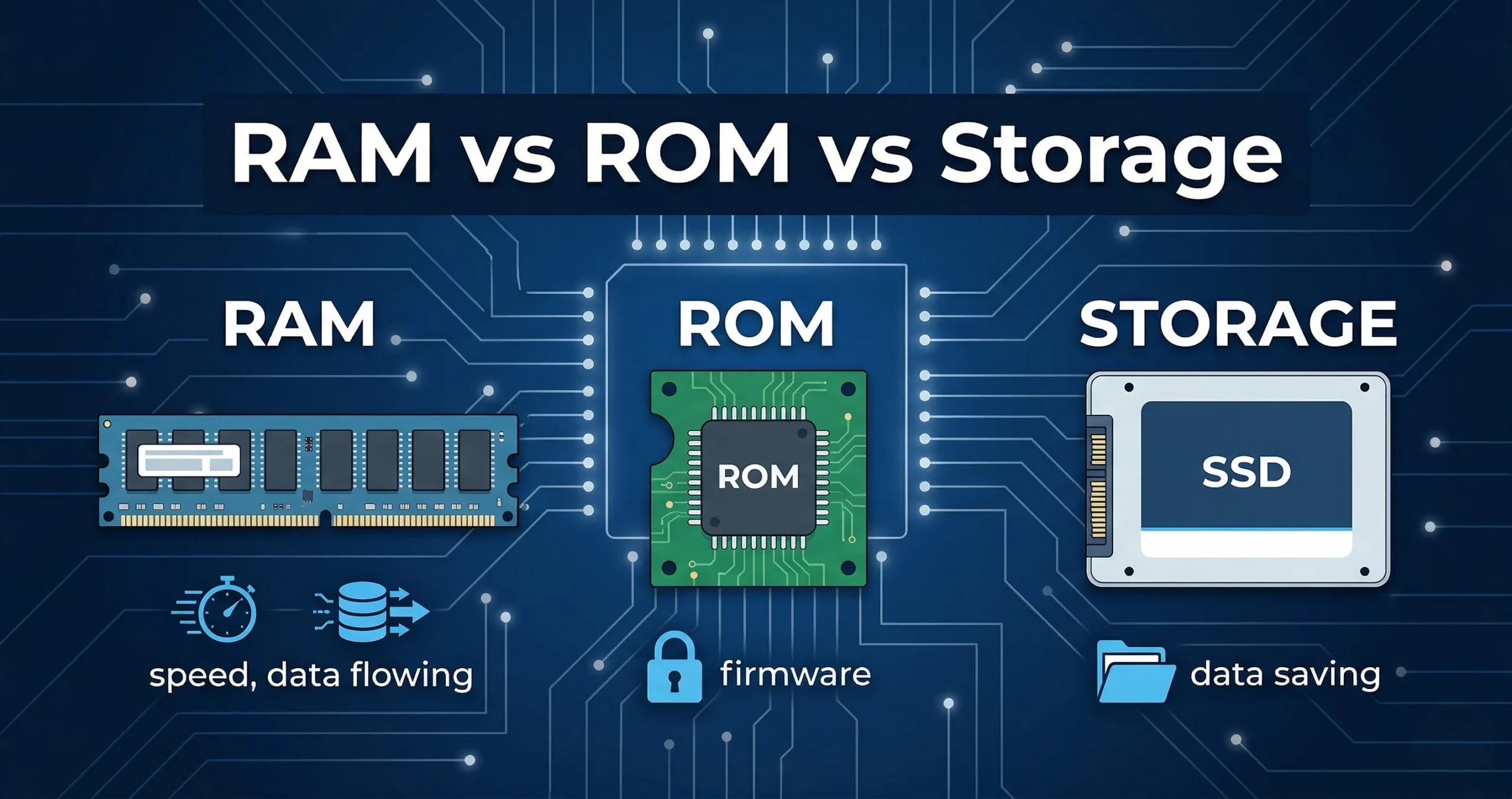
    If you want to stop feeling lost when tech terms get thrown around by salespeople or repair technicians, you are in the exact right place. In this guide, we will break down What is RAM and ROM in simple terms, explain the core RAM vs ROM difference, and clear up the overarching RAM vs ROM vs Storage difference. By the end of this read, you will understand exactly how these parts work together to power your favorite devices smoothly.

    What is RAM and ROM?

    To truly understand how your computer or smartphone operates, you first need to look at its memory systems. Memory is not just one single thing; it is divided into specific roles.

    Understanding RAM (Random Access Memory)

    RAM is your device’s short-term memory. It is a super-fast workspace where your computer places the data it is actively using right now. When you open a web browser, play a video game, or edit a text document, the processor loads that specific task into the RAM.

    Because RAM is so incredibly fast, your processor can grab information from it instantly without any lag. However, RAM is “volatile.” This means it only holds onto information while the device has power. If your computer crashes or you turn it off, everything stored in the RAM is wiped completely clean. This is why you lose your unsaved work when the power suddenly goes out.

    Understanding ROM (Read-Only Memory)

    ROM is your device’s permanent memory. Unlike RAM, the data stored inside ROM is not meant to be changed easily or frequently by the user. It contains the essential, foundational instructions that tell your device how to operate.

    Think of ROM as the basic instincts of your computer. When you press the power button, the processor looks at the ROM to figure out how to wake up the screen, check the keyboard, and start loading your operating system. ROM is “non-volatile,” meaning it keeps its data safely stored even when the device is completely powered down and unplugged.

    RAM vs ROM Difference

    Comparing these two types of memory helps paint a clearer picture of why your device needs both to function. Below is a simple table that breaks down the main distinctions.

    FeatureRAM (Random Access Memory)ROM (Read-Only Memory)
    Data RetentionVolatile (loses data when powered off)Non-volatile (keeps data without power)
    SpeedExtremely fastSlower compared to RAM
    Primary FunctionHolds active apps and current tasksHolds startup instructions (firmware)
    CapacityUsually higher (e.g., 8GB to 32GB)Usually very low (e.g., 4MB to 8MB)
    User AccessEasily read and written by the userMostly read-only, hard to modify
    Physical AppearanceLong, thin rectangular sticksSmall chips soldered to the motherboard

    The main RAM vs ROM difference comes down to flexibility versus permanence. RAM is a highly flexible, constantly changing environment. Data moves in and out of it thousands of times a second as you switch between apps. ROM, on the other hand, is stubborn and fixed. It is designed to safely guard the core startup codes so that no matter what happens to your active files, the computer always remembers how to turn itself on.

    When people experience a slow computer, the RAM vs ROM difference is often the key to fixing it. Upgrading your RAM gives you more active workspace, making the computer faster. You almost never upgrade or worry about your ROM unless you are doing deep, technical motherboard updates.

    Types of RAM and ROM

    Not all memory chips are manufactured the same way. Over the years, technology has evolved, giving us different variations of memory to suit different tasks. Understanding the Types of RAM and ROM can help you make better hardware choices.

    Types of RAM

    There are two main categories of RAM that work inside your devices:

    • SRAM (Static RAM): This is the fastest type of RAM available, but it is also the most expensive to manufacture. Because of the high cost, it is usually used in very small amounts directly inside the computer’s processor (often called CPU cache). It holds the absolute most critical data the processor needs right this second.
    • DRAM (Dynamic RAM): This is the standard RAM you buy for a computer. It is cheaper to make and can hold much more data than SRAM. However, it needs to be constantly refreshed with electrical pulses to keep its data alive. When you see a laptop advertised with “16GB of DDR4 Memory,” they are talking about DRAM.

    Types of ROM

    ROM has also evolved significantly from the early days of computing. Here are the primary variations:

    • PROM (Programmable ROM): This chip is manufactured completely blank. A programmer writes data to it once using special equipment. Once the data is written, it is locked forever and cannot be changed or erased.
    • EPROM (Erasable Programmable ROM): This type of chip improved upon PROM because it can actually be erased and rewritten. However, to erase it, the chip has to be removed from the computer and exposed to strong ultraviolet (UV) light for several minutes.
    • EEPROM (Electrically Erasable Programmable ROM): This is the modern standard used in almost all devices today. It can be erased and rewritten electronically without removing it from the motherboard. When your computer downloads a “BIOS update” or “Firmware update,” it is writing new data to the EEPROM.

    RAM vs ROM vs Storage Difference

    Now that we understand memory, we have to tackle the biggest source of confusion for most consumers: storage. You will often see tech specs talking about a 16GB phone vs a 128GB phone. That larger number is your storage.

    To clearly understand the RAM vs ROM vs Storage difference, imagine you are working in an office.

    Storage is your massive filing cabinet. This is where you keep all your documents, photos, videos, and downloaded applications. It holds a massive amount of stuff, and it keeps everything safe even when you leave the office and turn off the lights (non-volatile). Common examples include Hard Disk Drives (HDDs) and Solid State Drives (SSDs).

    RAM is your physical desk surface. When you need to work on a specific file, you take it out of the filing cabinet and put it on your desk. Your desk is small, but everything on it is within arm’s reach for immediate use. If your desk is too small (low RAM), you can only work on one or two files at a time. If you have a huge desk (high RAM), you can have ten files spread out at once without slowing down. But at the end of the day, the desk gets wiped clean.

    ROM is the instruction manual for the office. It sits in a locked glass box on the wall. You cannot easily change the words in the manual. It simply tells the security guard how to unlock the front doors, turn on the lights, and start the day.

    Many smartphone manufacturers confuse buyers by using the word “ROM” to describe internal storage. If an advertisement says a phone has “256GB ROM,” they are actually talking about flash storage, not true Read-Only Memory. True ROM is very small and strictly used for system startup.

    Which one is more important?

    A common question is whether RAM, ROM, or Storage is the most vital component. The truth is that they are all equally important because they operate as a unified team. Your device physically cannot function if any one of these three pieces is missing.

    However, from a user-experience perspective, RAM and Storage are the ones you need to care about most when spending money.

    If your goal is to store thousands of high-resolution photos, download heavy software, or keep an entire library of movies on your laptop, you need to prioritize Storage. A larger SSD means you will not have to constantly delete old files to make room for new ones.

    If your goal is performance, you need to prioritize RAM. If you like to have thirty web browser tabs open while streaming music and editing a video, you need a large amount of RAM. Without enough RAM, your computer will try to use your slower Storage drive as a temporary workspace, which causes severe lagging, freezing, and stuttering.

    ROM simply exists in the background doing its job. You will never need to go to a store and ask for “more ROM” to make your computer faster.

    Real-life examples and use cases

    To fully grasp the RAM vs ROM difference and how storage plays its part, let us walk through a few common daily scenarios.

    Scenario 1: Starting Up Your Laptop

    You press the power button on your laptop. First, the ROM activates. It sends a tiny, hardcoded sequence of instructions to check if the battery, keyboard, and screen are working. Once the ROM confirms the hardware is safe, it looks at your Storage drive to find Windows or macOS. The operating system is then lifted out of Storage and loaded into the RAM. Once it is in the RAM, your screen lights up, and your desktop appears ready for use.

    Scenario 2: Playing a Heavy Mobile Game

    You tap the icon for a large, graphically intense mobile game. Your phone reads the game files sitting permanently in your Storage. Because playing directly from storage would be incredibly laggy, the phone copies the current level’s graphics and sounds into the RAM. As you play, the game runs buttery smooth because the processor is rapidly reading the RAM. When you close the game, those files are cleared out of the RAM, freeing up the “desk space” for the next app you open.

    Scenario 3: Taking a Photograph

    You open your camera app (loading it into RAM). You point the camera and snap a picture of a beautiful sunset. In the split second after you press the button, the image is held temporarily in the RAM. When you click “save,” the phone writes that image file permanently to your Storage drive. Now, even if your phone battery completely dies, the photo is safe in the storage vault.

    Frequently Asked Questions (FAQs)

    Does adding more RAM increase my storage space?

    No, RAM and storage serve entirely different purposes. Adding more RAM increases your device’s ability to multitask and run heavy programs smoothly. It does not give you more room to save photos, videos, or files. You need a larger SSD or hard drive to increase your physical storage limits.

    Can I upgrade my ROM?

    Physically, no. The ROM chip is heavily integrated or soldered onto your device’s motherboard. However, you can update the software written on an EEPROM chip through a process called “flashing the BIOS” or updating your firmware. This is usually only done to fix major bugs or support newly released hardware.

    Why do smartphone companies say “128GB ROM” when it is actually storage?

    This is an old marketing habit that has stuck around. Early smartphones used a type of flash memory that evolved from ROM technology to store the operating system and user files. Over time, marketers kept using the term “ROM” to differentiate internal storage from removable SD cards. Technically speaking, they are referring to non-volatile flash storage, not traditional Read-Only Memory.

    Why does my phone say “Storage Full” when I am just trying to open an app?

    Sometimes devices need a little bit of empty storage space to act as an “overflow” area when your RAM gets completely full. If your storage is 100% full, the RAM has nowhere to offload temporary files, causing the phone to freeze up and display error messages. Clearing out some old videos usually fixes this.

    Will I lose my files if my RAM gets full?

    No, your files are completely safe. If your RAM gets full, your device will simply slow down significantly as it tries to juggle the active tasks. Your actual saved files (like word documents and pictures) are securely locked away in your storage drive, completely unaffected by how full your RAM is.

    Conclusion

    You now have a solid grasp of how memory and storage work behind the scenes to keep your electronics running smoothly. We covered the distinct jobs of your temporary active workspace, the permanent instructions that wake up your hardware, and the massive vaults where your digital life lives. The next time you shop for a new smartphone or troubleshoot a lagging computer, you will know exactly what those technical specifications mean. You are officially equipped to make smarter tech choices and understand your devices better than the average user.