The soldier of the future does not bleed. It does not sleep. And it does not hesitate.
Wars used to be won by the side with more people, more guns, and more courage. That equation is being rewritten — fast. In 2026, the most powerful weapon on any battlefield is not a tank or a nuclear warhead. It is an algorithm. AI in modern warfare has moved from research labs and science fiction into live combat zones, reshaping how nations fight, how commanders decide, and how ordinary people die — or survive.
This is not a distant warning. It is happening right now. The United States and Israel used AI-guided systems to strike over 2,000 Iranian military targets in weeks during the 2026 conflict. Iran responded with AI-assisted drone swarms hitting US bases across the Gulf. The machines are already at war. The question is whether we truly understand what we have unleashed.
This article breaks down exactly how AI in modern warfare works, who is building what, which real weapons are already deployed, and why the world needs to pay attention — before it is too late.
What Does AI Actually Do on the Battlefield?
Most people picture AI as a chatbot or a recommendation engine. On the battlefield, it is something entirely different — and far more consequential.
Artificial Intelligence in a military context acts as a supercharged decision-making engine. It can process satellite images, radar signals, drone footage, and radio communications all at once — in milliseconds. A human analyst might take hours to review the same data. An AI system does it before you finish reading this sentence.
In practical terms, this breaks down into three core abilities that are already changing conflicts:
Target Identification — AI algorithms scan thousands of live video feeds and flag enemy vehicles, weapons caches, or troop movements with striking accuracy. Think of it like facial recognition, but for tanks and missile launchers.
Autonomous Navigation — Modern AI drones do not need a pilot sitting in a control room. They take off, navigate complex terrain, avoid obstacles, and strike targets entirely on their own. Machine Learning allows them to improve with every mission.
Decision Support — AI helps generals and commanders plan smarter. It predicts enemy movements, models attack scenarios, and manages logistics at a speed no human team can match. The Pentagon has been integrating these tools across all branches of the US military since 2022.
The $500 Billion Global Arms Race Nobody Voted For
Here is something worth sitting with: the world is spending half a trillion dollars building smarter ways to kill — and most people have no idea it is happening.
Global military AI spending is projected to surpass $500 billion by 2030, driven not by ambition alone, but by fear. Security analysts call it a “security dilemma” — every nation builds AI weapons because it is terrified the other side will gain an unstoppable edge first. Nobody wants to start a war. But nobody wants to lose one either. So the race accelerates.
The United States leads the pack. The Pentagon’s AI defense budget exceeded $2.4 billion in fiscal year 2024 alone. DARPA — the Defense Advanced Research Projects Agency — runs hundreds of classified and public AI weapons programs, from autonomous drone swarms to AI-powered cyber warfare tools. Major contractors like Lockheed Martin, Raytheon, and Northrop Grumman are investing billions more on top of government funding.
China is closing the gap fast. Estimates place Chinese military AI investment between $1.6 billion and $2.7 billion annually, growing at roughly 20% per year. The People’s Liberation Army has integrated AI into surveillance drones, combat jet training simulators, and autonomous ground vehicles. Chinese tech giants like Huawei and DJI have deep, documented ties to military development programs.
Russia, despite a struggling economy, remains a serious player. Spending is estimated between $500 million and $1 billion annually. Russian forces have been field-testing AI battlefield systems in Ukraine and, more recently, in the Middle East — using real conflicts as live laboratories.
Other nations rapidly advancing in this space include Israel, the United Kingdom, South Korea, India, Iran, and North Korea. The race is not between two superpowers anymore. It is global.
The New Weapons: Drones, Missiles, and Cyber Tools
AI Drones — The Sky Has Changed Forever
The drone of 2026 is almost unrecognizable compared to the remote-controlled aircraft of a decade ago. Today’s Military Drone powered by AI does not need a human in the loop. It takes off, identifies threats, adapts its route, strikes, and returns — all without a single radio command from a controller.
Israel’s Harop drone — often called a “loitering munition” or kamikaze drone — is one of the most striking examples. It circles an area autonomously, detects active radar systems, and dives into them at high speed. No human authorizes each strike. The AI decides.
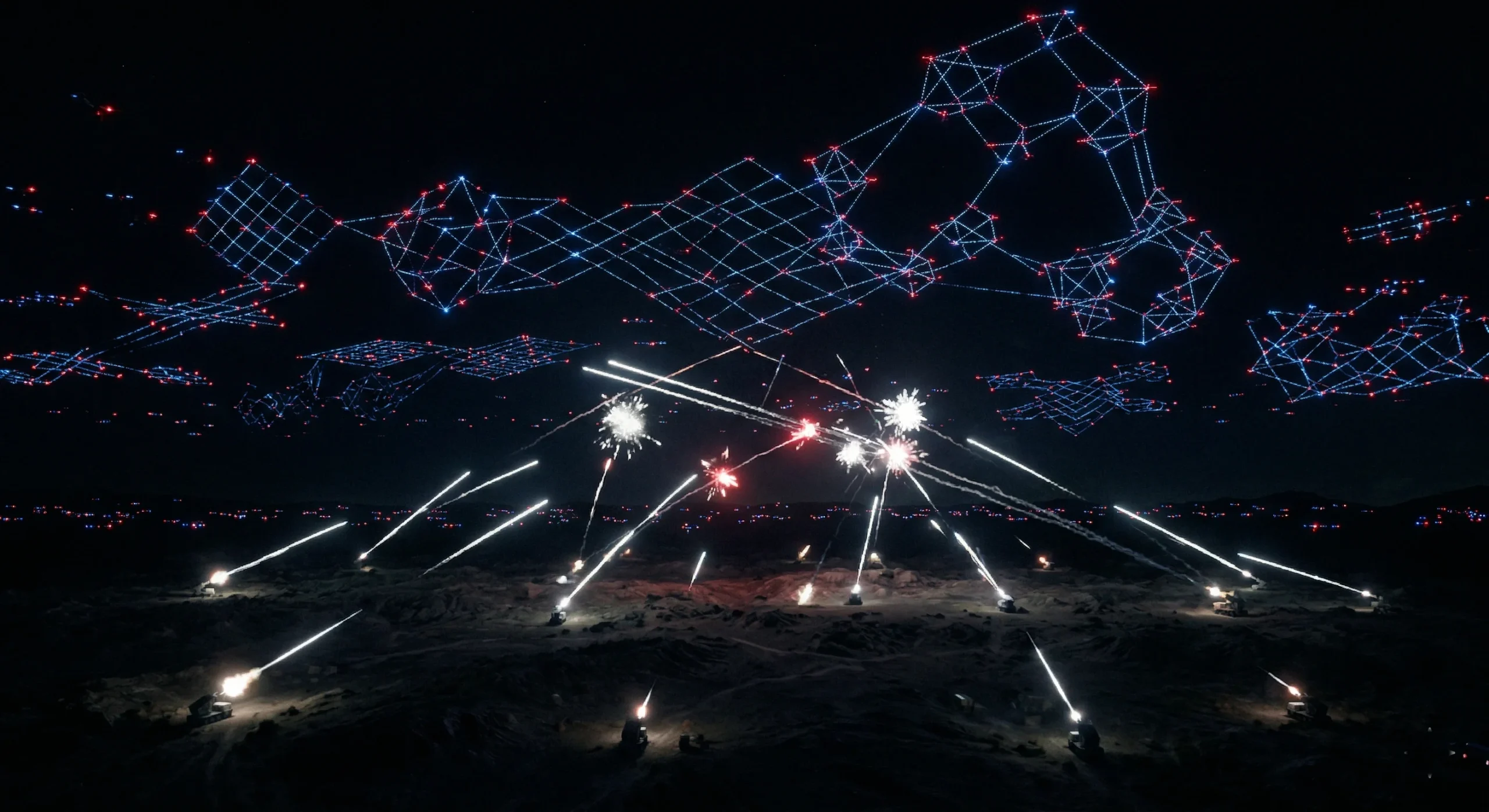
The United States is taking this even further with drone swarms — formations of hundreds of small AI drones that communicate with each other, divide tasks, and coordinate attacks in ways that overwhelm traditional air defenses. No single operator controls the swarm. The collective AI does.
AI-Guided Missiles — Smarter, Faster, Harder to Stop
Traditional missiles can be jammed, fooled by decoys, or confused by environmental interference. AI guided missiles technology solves this problem by making the weapon itself adaptive and intelligent.
AI missiles use machine learning to recognize specific target signatures — a particular ship design, a radar station, a specific type of vehicle — and continuously recalculate their flight path to avoid countermeasures. They do not just fly toward coordinates. They think their way there.
The US Navy’s LRASM (Long Range Anti-Ship Missile) navigates around enemy defenses and selects the most vulnerable point on a ship to strike. Russia’s Kinzhal Hypersonic Missile, flying at over Mach 10, integrates AI guidance systems that make interception nearly impossible. These are not prototype weapons — they are deployed and operational.
Cyber Warfare — The Invisible Battlefield
Beyond physical weapons, artificial intelligence defense systems now include AI-powered cyber tools capable of penetrating enemy networks, disabling power grids, disrupting financial systems, and crippling military communications. These attacks leave no smoke trail and no obvious attacker. AI makes cyber warfare faster, more targeted, and far harder to attribute.
Real Combat: What the 2026 Iran Conflict Revealed
The 2026 US-Israel military campaign against Iran became the first large-scale conflict where AI-powered weapons dominated both sides of the battlefield — and the results were eye-opening.
US B-2 stealth bombers used AI targeting systems to strike over 2,000 Iranian military sites within weeks. The precision was unprecedented. Meanwhile, Iranian forces launched hundreds of AI-assisted ballistic missiles and coordinated drone swarms at US military bases across Qatar, Bahrain, Kuwait, and the UAE. Some struck their targets. Many were intercepted by AI defense systems like Israel’s Iron Dome and the US Phalanx CIWS — systems that react in fractions of a second, far faster than any human operator could.
As General Kenneth McKenzie noted in a 2024 defense briefing: “Speed is the currency of modern warfare. AI gives you that currency in quantities no human force can match.”
The 2026 conflict did not just demonstrate the power of AI weapons. It proved they are no longer experimental. They are the standard.
The Moral Question That Cannot Wait
At the center of all this technology sits a deeply uncomfortable question: if a machine decides to kill someone — and gets it wrong — who is responsible?
Supporters of autonomous weapons make real arguments. AI does not panic. It does not freeze under fire. It does not make emotional, stress-driven mistakes. In theory, autonomous weapons powered by AI could be more precise than human soldiers, potentially reducing civilian casualties. And when your own soldiers are replaced by machines, fewer of your citizens come home in body bags.
But the opposing case is equally powerful — and harder to dismiss. A 2023 Stanford University study found that leading AI image recognition systems misidentified targets up to 15% of the time under difficult field conditions. In a war zone, a 15% error rate does not mean a slightly inaccurate report. It means thousands of people dying who should not have died.
There is also what experts call the “accountability vacuum.” International humanitarian law — including the Geneva Conventions — requires that a human being be accountable for decisions that cause civilian death. When an AI pulls the trigger, that accountability disappears. No court can prosecute an algorithm.
Human Rights Watch, the International Committee of the Red Cross, and hundreds of AI researchers have called for binding international restrictions on Lethal Autonomous Weapons Systems. The United Nations has been debating the issue since 2014. After more than a decade of discussion, there is still no binding agreement. The US, China, and Russia — the three biggest developers — have all resisted a ban.
Frequently Asked Questions
What are Lethal Autonomous Weapons Systems (LAWS)? They are weapons that use AI to identify, track, and engage targets without a human making the final decision to fire.
Which countries spend the most on military AI? The US leads at over $2.4 billion annually, followed by China at $1.6–2.7 billion, then Russia at an estimated $500 million to $1 billion per year.
Are AI weapons being used in real conflicts right now? Yes. AI-guided systems were used extensively by both sides in the 2026 US-Iran conflict. Israel’s Harop drone and the US Phalanx CIWS are already deployed in active zones.
Can AI weapons make mistakes? Absolutely. Environmental conditions, electronic interference, and data errors can all cause AI systems to misidentify targets — with deadly consequences.
Is there a law banning AI weapons? No binding international law currently exists. The UN has debated the issue for over a decade without reaching a binding agreement.
Conclusion
AI in modern warfare has stopped being a future problem — it became today’s reality faster than most governments, lawmakers, or citizens were ready for. The machines are already flying, firing, and deciding. The $500 billion arms race is not slowing down. The legal frameworks meant to protect human life in war have not caught up. And the window to set clear, enforceable rules is closing. What happens in the next few years — in treaty rooms, defense laboratories, and conflict zones — will shape the nature of war for the rest of this century. The real battle is not between nations. It is between human conscience and machine speed. And right now, the machines are winning.